
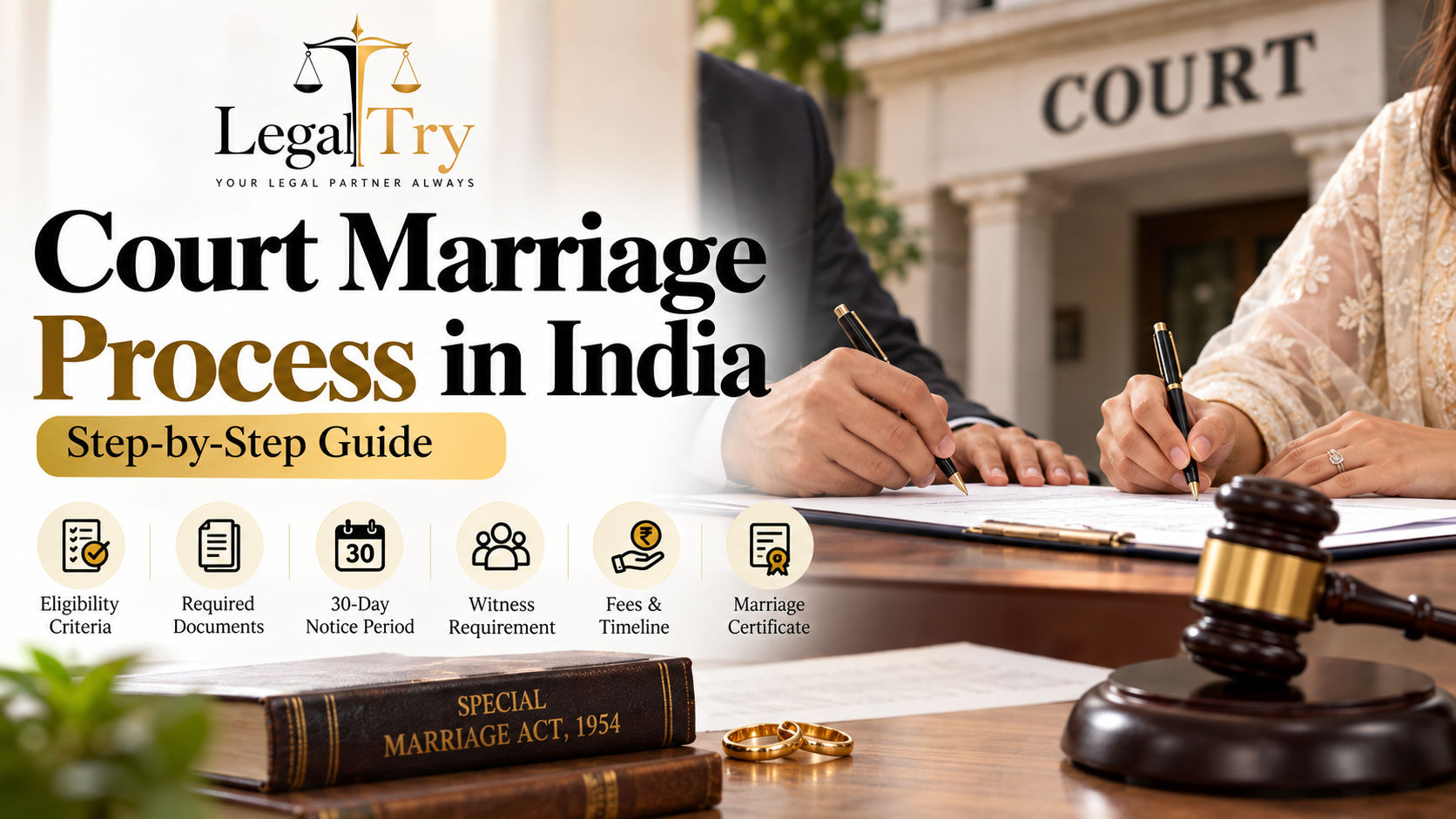
Court Marriage Process in India
The court marriage process in India provides a legal way for eligible couples to solemnize their marriage before a Marriage Officer without requiring a traditional religious wedding ceremony.
Court marriage is primarily governed by the Special Marriage Act, 1954. The Act provides the legal framework for giving notice of the intended marriage, publication of the notice, objections, solemnization of marriage and issuance of the marriage certificate.
In simple terms, the usual process is:
Check eligibility → Prepare documents → Submit marriage notice → Complete the statutory notice period → Deal with any objection → Appear before the Marriage Officer with three witnesses → Solemnize the marriage → Receive the marriage certificate.
The exact forms, fees, appointments and supporting documents can vary depending on the State or Union Territory and the concerned Marriage Officer.
What Is Court Marriage?
Court marriage generally means a marriage solemnized before a Marriage Officer under the Special Marriage Act, 1954.
Unlike a traditional marriage performed according to religious customs, a marriage under the Special Marriage Act follows a statutory civil procedure. The parties do not have to perform a religious ceremony as a condition of solemnization under this Act.
Court marriage can be relevant for couples from different religions as well as couples who prefer to marry through a civil legal process.
It is important to understand that court marriage and registration of an already solemnized marriage are not necessarily the same process. The applicable procedure depends on how and under which law the marriage is being solemnized or registered.
Court Marriage Process: Quick Answer
The court marriage process under the Special Marriage Act generally involves the following steps:
- Check whether both parties satisfy the legal conditions for marriage.
- Identify the appropriate Marriage Officer.
- Confirm the residence requirement.
- Prepare the required documents.
- Submit the notice of intended marriage.
- The notice is published according to the Act.
- A statutory 30-day period is provided for objections.
- If there is no valid objection preventing the marriage, the parties can proceed with solemnization.
- The parties appear before the Marriage Officer with three witnesses.
- The required declaration is signed.
- The marriage is solemnized.
- The Marriage Officer enters the marriage certificate in the Marriage Certificate Book.
Which Law Governs Court Marriage in India?
The primary law governing court marriage through this route is the Special Marriage Act, 1954.
Several provisions of the Act are particularly relevant to the court marriage process.
Section 4 provides the conditions that must be satisfied for solemnization.
Section 5 deals with the notice of intended marriage.
Section 6 deals with the Marriage Notice Book and publication of the notice.
Section 7 provides for objections to the proposed marriage.
Section 8 deals with the procedure after an objection is made.
Section 11 deals with the declaration by the parties and witnesses.
Section 12 deals with the place and form of solemnization.
Section 13 deals with the marriage certificate.
Section 14 deals with the situation where the marriage is not solemnized within the prescribed period after notice.
Who Is Eligible for Court Marriage?
The Special Marriage Act provides specific conditions that must be satisfied before a marriage can be solemnized.
Under Section 4, neither party should have a spouse living at the time of the marriage.
The parties must satisfy the statutory requirements relating to consent and mental capacity.
The male party must have completed 21 years of age and the female party must have completed 18 years of age.
The parties must also not fall within the prohibited degrees of relationship, subject to the exception provided by the Act where an applicable custom permits such a marriage.
Therefore, court marriage is not simply a matter of visiting a court and signing documents. The Marriage Officer has to consider whether the statutory conditions have been satisfied.
Can People of Different Religions Have a Court Marriage?
Yes.
One of the important features of the Special Marriage Act is that it provides a civil legal framework for marriage without requiring the parties to marry according to a particular religious ceremony.
For example, an eligible Hindu and Christian, Hindu and Muslim, Hindu and Sikh, or persons belonging to other religious backgrounds may marry under the Special Marriage Act, provided they satisfy the statutory requirements.
The Act can also be used by eligible couples belonging to the same religion who choose to solemnize their marriage through this civil procedure.
Court Marriage Process Step by Step
Step 1: Check the Eligibility Requirements
Before beginning the court marriage process, both parties should confirm that they satisfy the conditions prescribed by the Special Marriage Act.
This includes checking the minimum age, existing marital status, prohibited relationship requirements and statutory requirements concerning consent and capacity.
If either party was previously married, the legal status of the earlier marriage should also be verified before proceeding.
Step 2: Identify the Appropriate Marriage Officer
The notice of intended marriage must be given to the appropriate Marriage Officer.
An important requirement under Section 5 is that at least one of the parties must have ordinarily resided within the district of the Marriage Officer for at least 30 days immediately before giving the notice.
This residence requirement is important when deciding where to initiate the court marriage process.
Couples should therefore confirm the correct jurisdiction before preparing the notice.
Step 3: Prepare the Required Documents
The documents required for court marriage can vary depending on the State, local Marriage Officer and individual circumstances.
Commonly requested documents may include proof of identity, proof of age, address or residence proof, passport-size photographs and the prescribed forms, declarations or affidavits.
If either party was previously married, additional documents may be required.
For example, a divorced person may need to provide the final divorce decree, while a person whose previous spouse has died may need to provide the death certificate.
The exact document checklist should be confirmed with the concerned Marriage Officer before filing the notice.
Step 4: Submit the Notice of Intended Marriage
Under Section 5 of the Special Marriage Act, the parties must give written notice of their intention to marry to the Marriage Officer in the prescribed manner.
The notice contains relevant details of the parties and their intended marriage.
The Marriage Officer enters the notice in the Marriage Notice Book and follows the publication requirements provided under the Act.
Step 5: Publication of the Marriage Notice
After receiving the notice, the Marriage Officer follows the statutory procedure for publication of the intended marriage.
The notice is made available in the manner prescribed by the Special Marriage Act.
This publication forms an important part of the statutory court marriage process because it allows objections to be raised on the grounds recognised by the law.
Step 6: Complete the 30-Day Notice Period
One of the most important parts of the court marriage process in India is the statutory notice period.
After publication of the notice, the Act provides a period of 30 days during which an objection can be made.
This means that couples should not normally expect a newly initiated Special Marriage Act marriage to be completed on the same day as the initial notice.
The 30-day period should be considered while planning the marriage date.
Step 7: What Happens If Someone Objects?
An objection to a proposed marriage under the Special Marriage Act must relate to the statutory conditions for marriage.
A person cannot prevent the marriage merely because they personally disagree with the relationship.
If an objection is made, the Marriage Officer examines the objection according to the procedure prescribed by the Act.
The Marriage Officer must determine whether the objection establishes a legal ground that prevents the marriage from being solemnized.
If the Marriage Officer refuses to solemnize the marriage, the Special Marriage Act provides a right to appeal to the District Court within the prescribed period.
Step 8: Appear Before the Marriage Officer
If the statutory requirements have been satisfied and there is no unresolved legal obstacle, the couple can proceed with the solemnization of their marriage.
The parties must appear before the Marriage Officer according to the appointment and procedure applicable to the concerned office.
Step 9: Bring Three Witnesses
Three witnesses are required for solemnization under the Special Marriage Act.
The parties and the three witnesses are required to sign the prescribed declaration in the presence of the Marriage Officer.
Witnesses should carry the identity and other documents required by the relevant Marriage Officer.
Because local requirements can differ, couples should confirm the witness documentation before the scheduled solemnization date.
Step 10: Solemnization of the Marriage
The marriage is solemnized in accordance with the requirements of the Special Marriage Act.
Section 12 allows the marriage to be solemnized at the office of the Marriage Officer or, subject to the applicable requirements and additional fees, at another place within a reasonable distance.
The Act does not require a traditional religious ceremony for solemnization under this route.
Step 11: Marriage Certificate
After the marriage is solemnized, the Marriage Officer enters the details in the Marriage Certificate Book.
The certificate is signed by the parties and the three witnesses.
The marriage certificate is an important legal document because it provides official evidence of the marriage solemnized under the Special Marriage Act.
Couples should preserve the original certificate and obtain additional copies where required for future legal or administrative purposes.
Documents Required for Court Marriage
The exact document requirements can vary between States, Union Territories and Marriage Officers.
Generally, couples may be asked to provide:
- Proof of age.
- Proof of identity.
- Address or residence proof.
- Passport-size photographs.
- Prescribed application or notice forms.
- Required affidavits or declarations.
- Details concerning marital status.
- Divorce decree, if a party was previously married and divorced.
- Death certificate of the former spouse, where applicable.
- Identity and other required documents of the three witnesses.
It is advisable to confirm the latest document checklist with the relevant Marriage Officer before submitting the notice.
Court Marriage Documents for Previously Married Persons
If either party was previously married, the previous marriage must have legally ended before a new marriage can be solemnized under the Special Marriage Act.
Where the earlier marriage ended through divorce, the concerned party may need to provide the final divorce decree.
Where the earlier spouse has died, the death certificate may be required.
The purpose of these documents is to establish the person's current legal marital status.
Court Marriage Fees in India
There is no single court marriage fee that applies identically throughout India.
The amount can vary depending on the State or Union Territory, applicable rules and the services involved.
Fees may relate to:
- Notice filing.
- Marriage solemnization.
- Marriage certificate.
- Additional administrative services.
- Solemnization at a place other than the Marriage Officer's office, where permitted.
Couples should check the current official fee schedule applicable to the concerned Marriage Officer rather than relying on a generic amount found online.
How Long Does Court Marriage Take?
The statutory notice process is an important factor in determining the timeline.
Under the Special Marriage Act, a 30-day period is provided after publication of the notice for objections.
The total time can be longer depending on:
- Document verification.
- Appointment availability.
- Local administrative procedure.
- Marriage Officer workload.
- Public holidays.
- Whether an objection is filed.
- Whether additional documents are required.
Another important point is that if the marriage is not solemnized within three calendar months from the date of notice, the notice and proceedings arising from it generally lapse under Section 14, requiring a fresh notice.
Can Court Marriage Be Done in One Day?
For a new marriage being solemnized under the Special Marriage Act, couples should not generally expect a same-day process from the initial notice.
The Act provides a notice and publication procedure followed by a 30-day period for objections.
However, court marriage, registration of an already solemnized marriage and other marriage-registration procedures are different legal processes. The applicable procedure depends on the circumstances and the law under which the marriage is being solemnized or registered.
Court Marriage Without Parents
Parents are not required to be parties to a marriage under the Special Marriage Act simply because the couple is getting married.
The statutory process concerns the eligible parties, Marriage Officer and required witnesses.
For adult couples who satisfy the legal requirements, parental consent is not listed as a general condition for solemnization under Section 4.
However, couples should distinguish between the legal requirements for marriage and practical family or safety concerns that may arise in individual circumstances.
Can Parents Object to Court Marriage?
A person cannot stop a proposed marriage merely because they personally disagree with it.
Under Section 7, an objection must relate to one or more of the statutory conditions contained in Section 4.
Therefore, a personal objection or family disagreement is different from a legally recognised objection under the Special Marriage Act.
If an objection is filed, the Marriage Officer follows the statutory procedure to determine whether the objection has a legal basis.
Court Marriage for Interfaith Couples
The Special Marriage Act is particularly relevant to couples belonging to different religions who want to marry through a civil legal procedure.
An interfaith couple does not have to perform a religious marriage ceremony merely to use the Special Marriage Act.
Both parties must still satisfy the statutory conditions, including age, marital status and other requirements.
An interfaith couple should also understand the distinction between marrying under the Special Marriage Act and changing one's religion before marrying under another personal law.
Court Marriage for Couples From Different States
Couples whose permanent addresses are in different States can potentially marry under the Special Marriage Act.
However, the residence requirement for giving notice must be satisfied.
At least one party must have resided in the relevant district for at least 30 days immediately before the notice is given.
Therefore, couples living in different States should determine which Marriage Officer has jurisdiction before starting the process.
Court Marriage Certificate
The marriage certificate is one of the most important documents issued after solemnization.
After the marriage is solemnized, the Marriage Officer enters the certificate in the Marriage Certificate Book.
The parties and three witnesses sign the certificate.
The certificate can subsequently be used as proof of marriage for various legal and administrative purposes, subject to the requirements of the concerned authority.
It may be required when dealing with matters such as immigration, visas, passports, insurance, banking, employment records, inheritance or other official documentation.
Court Marriage vs Marriage Registration
Court marriage and marriage registration are often used interchangeably in everyday conversation, but they can refer to different legal processes.
In a court marriage under the Special Marriage Act, the marriage itself is solemnized through the statutory process before the Marriage Officer.
Marriage registration can refer to registering a marriage that has already been solemnized under another applicable law or form.
The documents, procedure, fees and legal provisions applicable to registration can therefore differ from those applicable to a new marriage under the Special Marriage Act.
Court Marriage Under the Special Marriage Act: Important Sections
Section 4 – Conditions for Marriage
Section 4 contains the statutory conditions that must be satisfied before a marriage can be solemnized under the Special Marriage Act.
These include conditions concerning existing spouses, age, consent or mental capacity and prohibited relationships.
Section 5 – Notice of Intended Marriage
Section 5 provides for the written notice of intended marriage to the Marriage Officer.
Section 6 – Marriage Notice Book and Publication
Section 6 deals with the Marriage Notice Book and publication of the notice.
Section 7 – Objections to Marriage
Section 7 provides the statutory framework for objections to the proposed marriage.
Section 8 – Procedure After Objection
Section 8 deals with the procedure that the Marriage Officer follows after receiving an objection.
Section 11 – Declaration by Parties and Witnesses
Section 11 requires the parties and three witnesses to make and sign the prescribed declaration in the presence of the Marriage Officer.
Section 12 – Place and Form of Solemnization
Section 12 deals with the place and form in which the marriage may be solemnized.
Section 13 – Marriage Certificate
Section 13 provides for the entry of the marriage certificate in the Marriage Certificate Book.
Section 14 – Fresh Notice
Section 14 deals with the situation where the marriage is not solemnized within three calendar months after the notice.
Common Mistakes to Avoid in Court Marriage
Assuming Court Marriage Is Always Same-Day
A new marriage under the Special Marriage Act is subject to the statutory notice procedure and 30-day objection period.
Choosing the Wrong Jurisdiction
The residence requirement should be checked before giving notice.
Not Preparing Documents in Advance
Missing or incorrect documents can cause delays.
Forgetting the Three Witnesses
Three witnesses are required for solemnization under the Special Marriage Act.
Providing Incorrect Information
All information submitted to the Marriage Officer should be accurate and supported by appropriate documents.
Ignoring the Three-Month Notice Period
If the marriage is not solemnized within the statutory period after notice, a fresh notice may be required.
Court Marriage Process Checklist
Before starting the process, couples should check the following:
Eligibility
Both parties satisfy the statutory age requirement.
Neither party has a living spouse.
The parties satisfy the requirements concerning prohibited relationships.
The parties satisfy the applicable consent and capacity requirements.
Residence
At least one party has the required residence in the relevant district before giving notice.
Documents
Identity proof is available.
Age proof is available.
Residence proof is available.
Photographs are available.
Required affidavits and declarations are prepared.
Previous marriage documents are available where applicable.
Witnesses
Three witnesses are available.
Witnesses have the required identity documents.
Process
Notice of intended marriage is submitted.
The statutory notice period is completed.
Any objection is dealt with according to law.
The parties appear before the Marriage Officer.
The marriage is solemnized.
The marriage certificate is issued and preserved.
Frequently Asked Questions About Court Marriage
What is the court marriage process in India?
The court marriage process generally involves checking eligibility, identifying the appropriate Marriage Officer, satisfying the residence requirement, submitting a notice of intended marriage, completing the statutory notice period, dealing with any valid objection, appearing with three witnesses, solemnizing the marriage and obtaining the marriage certificate.
How many days does court marriage take?
A new marriage under the Special Marriage Act is subject to a statutory notice and objection period of 30 days. The overall timeline can be longer depending on appointments, documents, administrative requirements and whether an objection is filed.
How many witnesses are required for court marriage?
Three witnesses are required for solemnization under the Special Marriage Act.
What is the minimum age for court marriage?
Under the Special Marriage Act, the male party must have completed 21 years and the female party must have completed 18 years.
Can an interfaith couple have a court marriage?
Yes. Eligible couples belonging to different religions can marry under the Special Marriage Act, subject to the statutory conditions.
Can court marriage be done without parents?
Parents are not generally required to give consent for an eligible adult marriage under the Special Marriage Act. The statutory requirements focus on the parties, the Marriage Officer and the required witnesses.
Can parents object to court marriage?
An objection under the Special Marriage Act must be based on a statutory ground relating to the conditions for marriage. Personal disagreement alone does not constitute the statutory basis for an objection.
Can court marriage be done without a religious ceremony?
Yes. The Special Marriage Act provides a civil procedure for solemnization and does not require a religious ceremony as a condition of marriage under the Act.
Is a court marriage certificate legally valid?
Yes. When the marriage is validly solemnized under the Special Marriage Act and the certificate is entered as required, the marriage certificate serves as official evidence of the marriage under the Act.
Can court marriage be done in one day?
A new marriage under the Special Marriage Act is generally subject to the statutory notice process and 30-day objection period. Therefore, couples should not assume that a newly initiated SMA marriage can be completed on the same day.
What happens if someone objects to court marriage?
The Marriage Officer examines the objection according to the procedure prescribed by the Special Marriage Act. The objection must relate to the statutory conditions for marriage.
What happens if the marriage is not completed within three months?
If the marriage is not solemnized within three calendar months from the date of notice, the notice and proceedings arising from it generally lapse, and a fresh notice is required.
Court Marriage Process: Key Takeaways
The court marriage process in India under the Special Marriage Act provides a statutory civil route for eligible couples.
The most important points to remember are:
- Court marriage is primarily governed by the Special Marriage Act, 1954.
- Both parties must satisfy the statutory eligibility requirements.
- The minimum age is 21 for the male party and 18 for the female party under Section 4.
- At least one party must satisfy the 30-day residence requirement before giving notice.
- A written notice of intended marriage is required.
- The notice is published according to the statutory procedure.
- A 30-day period is provided for objections.
- Three witnesses are required for solemnization.
- The Marriage Officer enters the marriage certificate after solemnization.
- A fresh notice may be required if the marriage is not solemnized within the statutory three-month period.
- Documents, fees and administrative procedures can vary by jurisdiction.
Conclusion
The court marriage process in India provides an important legal route for couples who want to solemnize their marriage under the Special Marriage Act, 1954.
The process involves more than simply signing documents at a court. Couples generally need to satisfy the eligibility requirements, identify the correct Marriage Officer, meet the residence requirement, submit the notice of intended marriage, complete the statutory 30-day notice period, address any valid objection, appear with three witnesses and complete the solemnization process before receiving the marriage certificate.
Couples should also remember that court marriage, marriage registration and registration of an already solemnized marriage can involve different procedures. The correct process depends on the circumstances and the law under which the marriage is being solemnized or registered.
If you are planning a court marriage and are unsure about jurisdiction, documents, interfaith marriage, previous marriage, objections or the applicable procedure, consulting a qualified family-law lawyer can help you understand the requirements applicable to your circumstances.
Legaltry provides legal information and assistance to help individuals understand marriage, family law and other legal procedures in India.
Comments